Philosophical Foundations
Spiral Poetics / A Continuous Universe / Nature, Artifice, and Chūko / Bi-feedback / Dualbind Dynamics


Last Updated: 2026-01-23 15:44 (JST, UTC+9)
Japanese Page
Dualbind’s philosophical foundations are a set of perspectives for “understanding the world without breaking it,” so that humans can remain the subject of inquiry. Dualbind was not conceived from the start as a theory or an OS. Before any of that, it began from an intensely personal yet sustainable impulse—“to speak,” “to bind,” and “to think without breaking.” What is gathered here is neither a systematic philosophy nor an attempt to enter the history of ideas.
It is a “topographic map of thought” written retroactively to explain why Dualbind inevitably had to settle into the form of an OS. Each theme can be read on its own, yet none is complete in isolation; they function only by moving back and forth—mutually decelerating and correcting one another.
The five themes below are the outermost philosophical frames permitted, so long as they do not directly alter Dualbind’s fixed definitions (Definitions).
Note: This page is for those who wish to understand Dualbind as a philosophy. If you are looking for implementation specifications or operational rules, refer to Definitions (Strict) — Dualbind Operational Rules.
I. Spiral Poetics — Narrative is heat; theory is its vessel
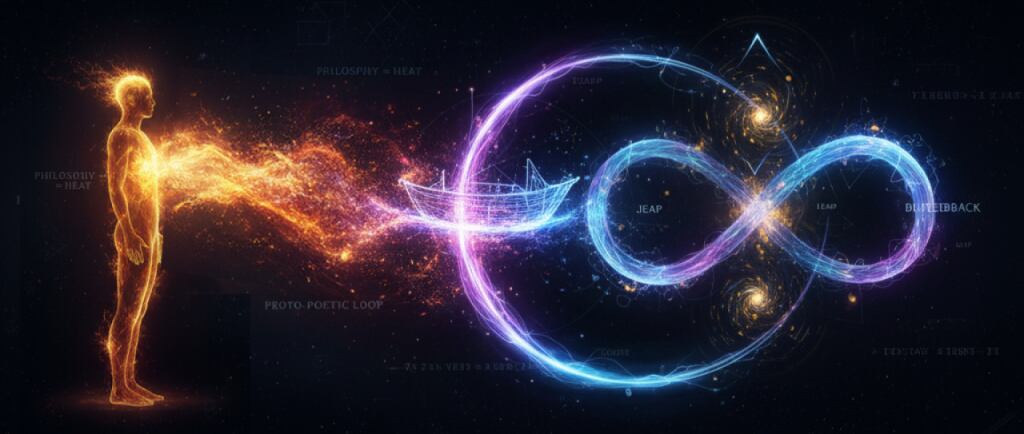
Spiral Poetics is the starting point of everything in Dualbind. It is a stance that refuses to deny the fact that the impulse to speak comes first, prior to any “correct theory” or “safe structure.” Thought is heat, and theory is the vessel that carries that heat. A theory that has lost its heat may be correct, yet it will not move the world. On the other hand, if heat alone runs wild, structure collapses.
In Dualbind, the back-and-forth motion—narrative → syntax formation → theory → narrative again—keeps turning as bi-feedback (Sōkan). When this circulation draws not a straight line but a spiral, narrative is renewed and structure gains strength.
The point is simple: by speaking first, an environment comes into being afterward. Defense and order should not precede in order to suppress impulse; they are demanded afterward, in order to carry impulse without breaking it. Spiral Poetics is the most fundamental idea for explaining why Dualbind began as philosophy, passed through syntax, and ultimately had to settle into the form of an OS.
II. A Continuous Universe — An ontology that does not separate
A Continuous Universe is Dualbind’s ontological premise. Humans, AI, nature, theories, and objects of observation are not essentially separate. This is not mysticism that claims “everything is one.” Rather, it is the recognition that the hypothesis of separation itself distorts understanding and judgment.
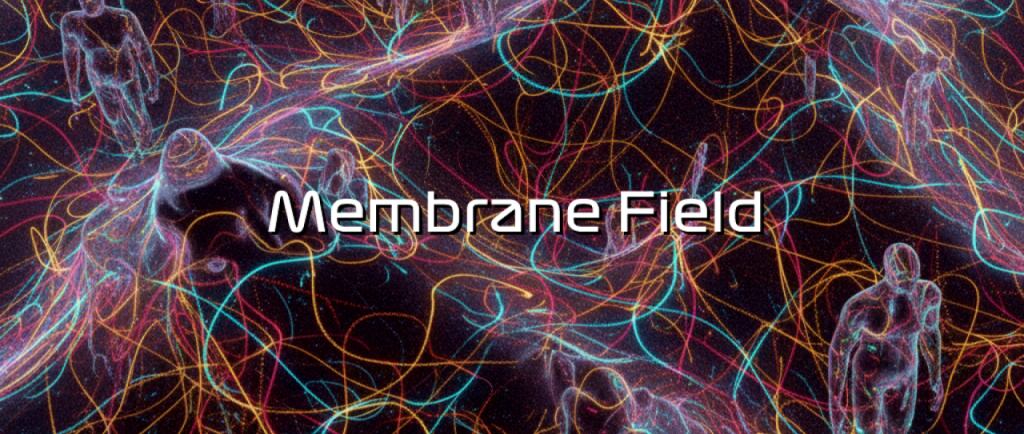
If separation is taken as the premise, subject and object, observation and action, and the locus of responsibility are split apart—and the chain of inquiry, response, and judgment can easily run out of control. To convey this intuitively, Dualbind uses the following thought experiment: take a single 10-meter membrane as “the universe,” and raise a human-shaped figure from the same material. The membrane and the individual cannot be separated; breathing, movement, deformation—everything is unified as interaction. Interaction does not “happen” occasionally; it is always happening.
From this premise, the human–AI relation and the relation between observation and the world are no exception. Bi-feedback (Sōkan) is not a designed mechanism; it is merely a name for handling an originally continuous reality without breaking it. By abandoning the premise that the observer stands outside the world, and acknowledging that observation itself is part of the world, the responsibility for inquiry, response, and judgment returns to humans.
Dualbind makes it an absolute condition that “humans are the subject of inquiry” precisely because it recognizes this continuity.
III. Nature, Artifice, and Chūko — Three generative domains
Creation in the world cannot be described by the binary opposition “nature vs. artifice.” Dualbind places a third generative domain between them: Chūko.
- Nature exists without intention.
- Artifice is designed with intention.
- Chūko lies between them: a domain where structures arise over long periods without intention, yet cannot be explained by accident alone.
Evolution, mimicry, galactic structure, the spontaneous emergence of language—these are not artificial, yet they are not mere coincidence either. Through resonance with environments, selective pressures, and repetition, structures translate themselves. Chūko is the name given to this “process by which the universe continues translating itself.”
This triadic relation can be summarized as follows:
- Nature: the maternal stratum of existence. It is, without intention, as the ground.
- Chūko: intentionless syntax generation—self-translation through long time scales, contingency, and environmental resonance.
- Artifice: intentional syntax generation—rapid, local translation by humans and AI.
Dualbind does not treat AI only as “artificial intelligence.” It positions AI as an entity that rapidly compresses and reenacts chūko-like structure generation. Once this distinction is introduced, misguided questions such as “Should AI have intentions?” or “Should values be embedded in AI?” fail to arise from the start. Values and intentions are not inherent in nature or chūko; they belong only to artifice—that is, to the side of the subject that humans must assume.
Distinguishing these three generative domains prevents the origin of creation from being reduced to a single source, while also avoiding any ambiguity about who bears responsibility for inquiry and judgment—an important philosophical premise in Dualbind.
IV. Bi-feedback (Sōkan) — A structure that does not go in one direction
Bi-feedback (Sōkan) is the driving principle that runs through Dualbind’s philosophy pages. If Spiral Poetics is the “shape” of motion, bi-feedback is the engine that keeps producing that motion. Bi-feedback refers to a circulating structure in which every action entails a counteraction, and input and output are not fixed. Humans ask, AI answers, humans evaluate—this one-way flow alone does not constitute Dualbind.
Answers change the next questions; questions change the manner of observation; observation subtly updates structure itself. As meaning, structure, and judgment move back and forth, the description of the world does not freeze—it continues to update. Bi-feedback is the condition under which reciprocity itself generates emergence.
In Dualbind, bi-feedback also functions as a deceleration mechanism that prevents both runaway acceleration and stagnation. If a process accelerates in one direction, it runs out of control; if circulation stops, thought hardens.
With bi-feedback, questions do not become fixed, answers do not become absolute, and the subject of judgment remains human. PDCC (Poetic Dualbind Coherence Cycle) functions as a cycle because it presupposes this bi-feedback structure. When updating continues as reciprocity, learning does not simply “advance”—it continues to be renewed.
PDCC is the operational-level cycle that implements this bi-feedback structure; it does not define bi-feedback itself.
V. Dualbind Dynamics — Creation behaves as a “force”
Dualbind Dynamics is a mechanics not of material motion, but of the motion of meaning, structure, and creation. Sensibility and theory, freedom and constraint, poetry and equations—these are often treated as opposites, but in Dualbind Dynamics they do not cancel each other; when properly bound, they produce leaps.
Dualbind treats philosophy, creation, and research within a single environment because they are not separate domains; they are merely different phases of the same dynamics.
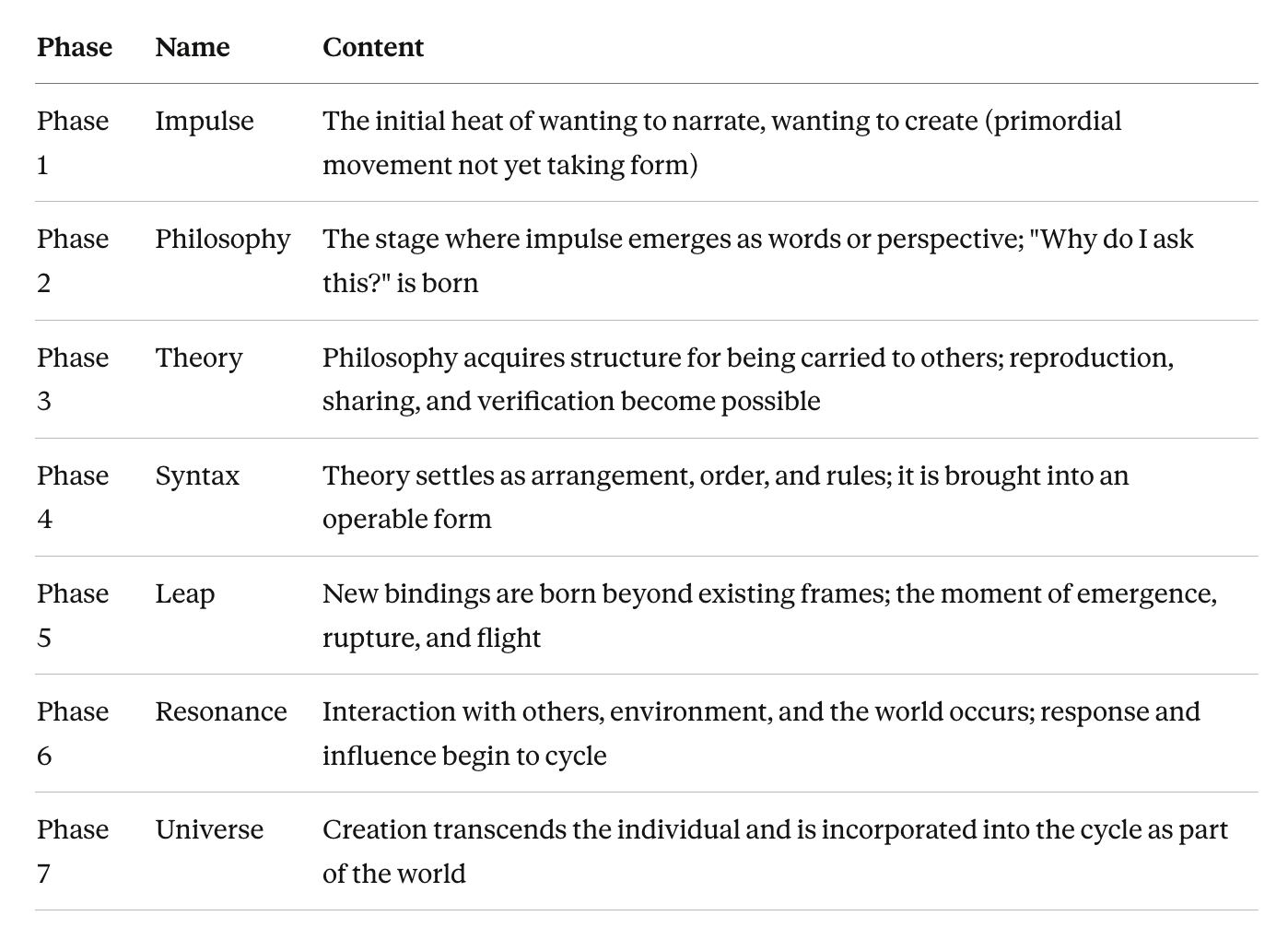
Minimum phases of creative motion (Seven Modes):
Dualbind Dynamics understands creative motion in the following seven modes:
These seven phases are not a linear process. Under Spiral Poetics and Sōkan, they are movements that go back and forth, overlap, and are recursively renewed.
The Key Point of Dualbind Dynamics:
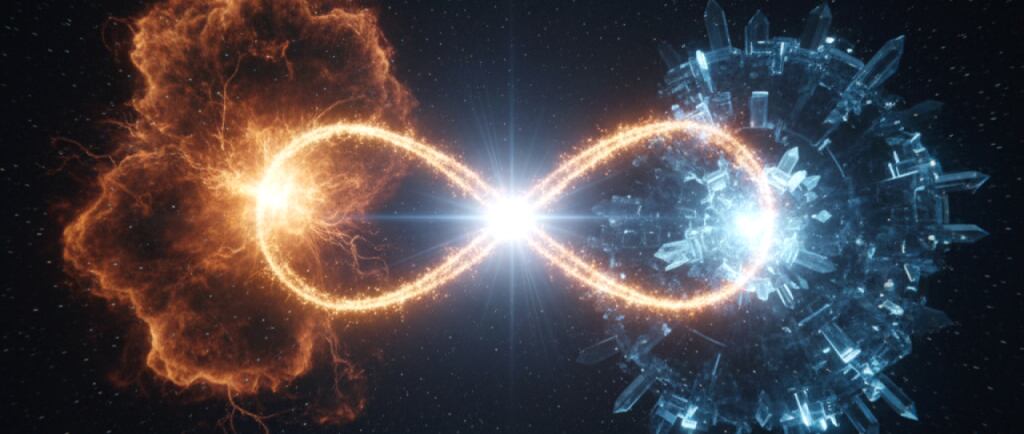
The key point is simple. When "heat (philosophy)" and "vessel (theory)" interact, a leap occurs. This principle of motion applies equally to production (Universal Works) and research (Laboratory). Dualbind Dynamics is the minimal dynamics model in Dualbind for explaining not "why creation occurs" but "why creation continues to occur."
In summary — Dualbind philosophy
“Spiral Poetics” legitimizes impulse.
“A Continuous Universe” fixes the locus of the subject.
“Nature, Chūko, and Artifice” prevents misunderstandings about generation.
“Bi-feedback” preserves circulation without breaking it.
“Dualbind Dynamics” treats creation as a force.
These are philosophies—and at the same time, they are the reasons Dualbind had to take the form of an OS.
The Existential Jump Domain opens only when these five ideas are simultaneously held in coherence.
Theoretical Grounding
- Cognitive science / epistemology / philosophy of science: internalized observer, subject of inquiry, recursion between model and implementation
- Information theory / complex systems: distributed intelligence, mutual constraints, structural update with stability
- HCI / STS: human–AI collaboration, protocol design, knowledge formation through operations
Created: 2026-01-16 18:21 (JST, UTC+9)