
Poetic Truth
How Dualbind Handles Truth

Last Updated: 2026-01-22 18:43 (JST, UTC+9)
Japanese Page
Note
This page is not a definition of truth itself, but a guide to how Dualbind treats truth.
Introduction
Dualbind does not treat truth as a single kind of thing.
There is scientific truth that can be verified and shared, and at the same time there is poetic truth that arises only from a particular observer's act of observation.
Dualbind places these two side by side without setting them in opposition.
Scientific Truth and Poetic Truth
Scientific truth describes the world as structure. It is reproducible, shareable, and powerful.
Yet it does not directly answer the questions:
"Why do we ask this?"
"Why does this hold meaning for me?"
Poetic truth is born at the moment a question arises, at the instant the observer and the world are re-bound. It cannot be reproduced. Yet it holds the power to keep the question alive as something lived.
The Role of Poetic Truth in Dualbind
Dualbind handles poetic truth not to make answers ambiguous, but for the opposite reason. When poetic truth is excluded, only the formal question remains and the responsibility for judgment belongs to no one.
By treating truth as an event bound to observation, Dualbind returns the subject and responsibility of the question to the human.
Shortest Table of Roles
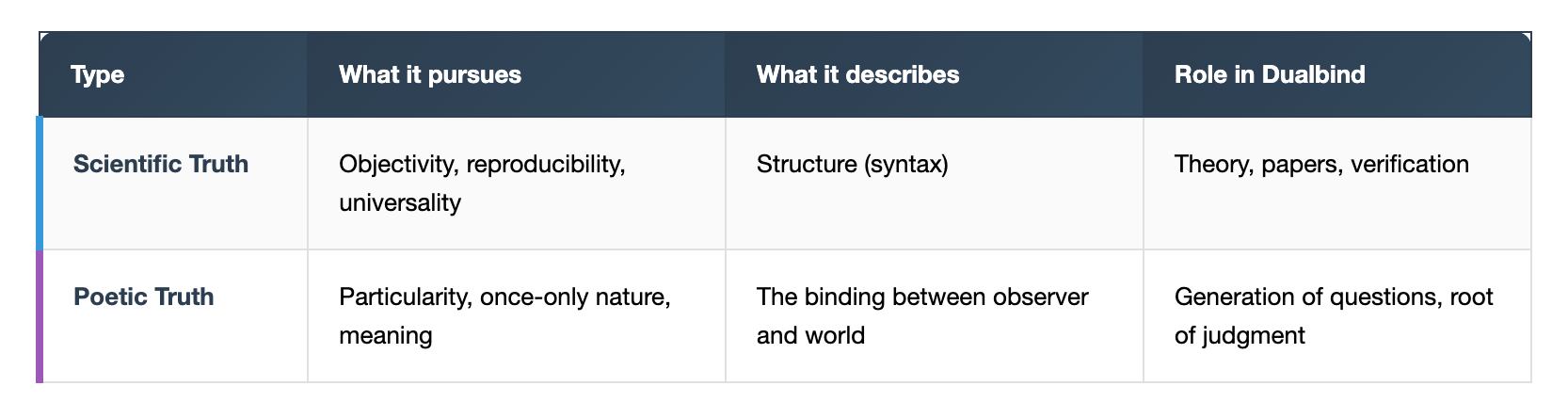
The Framework of Poetic Truth: The Five Questions
Poetic truth is not an "answer" but a framework that keeps questions continuously renewed.
1. What is existence? — Questions the premise of structure
2. What is arrangement? — The way things are placed changes their nature
3. What is relation? — Connections define the world
4. What is action? — Structural change acts as force
5. Suspended questions — Questions that change shape each time they are answered
These are not problems to be solved once and for all, but questions that keep the structure updating.
As long as the question lives, truth lives too.
Conclusion
Dualbind invites the reader not as a mere consumer but as an observer.
We can prepare maps (papers) and protocols (specifications).
But posing the question, observing, judging, and moving forward is always your own act.
Poetic truth is the truth that belongs uniquely to you — it arises at the moment you observe, question, and act.
Theoretical Grounding
- Aesthetics / hermeneutics: truth conditions via poetic description, semantic density, reader participation
- Cognitive linguistics: metaphor, conceptual blending, compression and leap
- Psychology: introspection, attention, coupling of affect and reasoning
Read Next
Created: 2026-01-22 18:43(JST, UTC+9)